Reader Mailbag: My Olympics Commentary

From time to time, I will take time to respond to the numerous questions or comments I receive from readers via e-mail. Let’s get things started right now. Please send me your questions.

I’m waiting.

OK, I’ve waited long enough. Seeing no questions or comments, I will instead respond to a comment published on the editorial pages of the September 8, 2008 issue of Time magazine. This comment was sent in by Mark Reese, a resident of Salt Lake City:

    “I am happy for Michael Phelps’ success in Beijing. But it is not apt to compare Phelps with Mark Spitz and the seven gold medals Spitz earned at the 1972 Munich Olympics. Spitz did not have the technological advantages of superspeedy pools and laser-sleek swimsuits. Nor did Spitz wear a streamlined swimming cap to cover his hair. In fact, he swam those events with a mustache. Spitz won his medals the old-fashioned way. It has taken more than 30 years of innovation and technology for anyone to come close to his Olympic success.”

Reading this editorial made my blood boil… when I discovered that Time magazine doesn’t so much as send a Time coffee mug to readers who have their comments published. Shame on you, Time, shame on you. Let me say right now: if I publish any comments sent as e-mail from readers of my blog, I will e-mail the readers a high-quality image of a coffee mug. It will look something like this:

Now, let me say that Mark Reese doesn’t know what he’s talking about. The logic train left the station, and he was left standing on the station platform as it pulled away. And then a pigeon pooped on his head. The pigeons can easily fly right into the train station because the doors are constantly swooshing open with the steady comings and goings of train passengers. It really creates quite an unsanitary situation.

Mr. Reese is comparing apples with oranges. Unless the Chinese invented some kind of time machine that transported Phelps and his high-tech swimming pool and head cap and lack of mustache back to 1972, the number of medals someone wins has nothing to do with the technology, because in any given Olympics year every athlete is competing against each other with the same technology. All of the athletes this year, for example, were swimming in the same superspeedy pool against each other. Yet they didn’t all win eight medals.

It is fair to look at world-record times and attribute the improvement to technology; technology can shave an extra millisecond or two off a time. But that’s not what Mr. Reese was referring to. He was referring to the number of medals won. And that has nothing to do with the technology, but only how well a given athlete measures up to his or her peers in any given event. For that reason, Michael Phelps deserves the kudos he has received. And I changed my mind; Mr. Reese doesn’t deserve a Time coffee mug.

Delicious Recipe for Lettuce

This is a family favorite. I’ve had this recipe written down on a well-weathered card for years, and thought it was time to share.

Serves 1-4. Allow 10-45 minutes for preparation.

     1. Obtain head of lettuce. This can be from the grocery store, from a lettuce field (or wherever it is lettuce comes from, I’m really not sure), or from the neighbor’s refrigerator if they keep their front door unlocked and you can sneak in when they’re not looking.

     2. Rinse lettuce. This step is optional, but I’ve found the lettuce turns out better this way. In particular, I’ve found that lukewarm to cold water is the best liquid to use for rinsing. You can usually find water in the kitchen faucet.

     3. Serve.

Alternative:

     3b. Serve chilled.

That’s all there is to it — enjoy!

Related blog post: From the Less Mature Files: McDonald’s Launches Arch Deluxe, a satirical story I wrote in college that involved lettuce.

More Meatloaf, Please?

Wow, so there’s some closet Meatloaf fans out there.

Well, I didn’t just record one song. No sir. When I jam to the piano, I jam for at least three songs. Sometimes four. Or however long it takes for the police to arrive.

So here’s another one, which focuses on the trials and tribulations of a car’s rearview mirror, and the continuing technical challenge of objects appearing smaller than they really are, which seems like a serious safety flaw the car companies should put their heads together on to finally get fixed.

My favorite part in this one also starts around 4:30. That’s when the neighbors, so exasperated with my loud playing, use a sledgehammer to break through the drywall and then attempt (unsuccessfully at first) to saw my keyboard in half with a chainsaw. Eventually they succeeded, but not before the first chainsaw broke and they had to go to another neighbor down the road to borrow a second chainsaw. Don’t worry, I edited that part out.

Once again, see if you can play along and count how many wrong keys I hit. It’s fun! (Here’s a freebie: the very first note is wrong!)


Untitled from Scott Smith on Vimeo.

How I Unwind

One way I fight stress is by jammin’ on my keyboard. I’m not really a composer, so I just set the iPod to shuffle and jam to whatever songs come up. Every now and then, a Berlitz “Learning French” audio book starts playing. I have no idea why. I don’t remember buying this through iTunes, and I’ve never had a desire to learn French. Nothing tosses water on a good jam session more than “Making Small Talk in French, Part III.”

I wanted to try out the Vimeo video sharing service, so decided to make my first music video.

It was quite a production, and required months of preparation and an extensive crew. Everything had to be perfect: the audio, the lighting, the editing and post production.

Um.

Actually, I just aimed a point and shoot camera in the general direction of the keyboard, and started jamming to Meatloaf.

Yes, Meatloaf.

I believe it is possible to both like and dislike Meatloaf at the same time.

I find his music a little over the top, but I also find it very musical — almost rock n’ roll orchestral. It’s kind of fun to jam along on the piano.

So, here’s my Vimeo test. I manage to hit the wrong notes quite a few times. Hey, at least I’m not singing along.

My favorite part starts around 4:30. That’s when I accidentally knock the keyboard over, and it catches on fire, sending flames shooting up the back wall. Don’t worry, I edited that part out.


Jamming on the piano from Scott Smith on Vimeo.

Some Saturday Night Creative Photography

I decided to take a brief break from working tonight for some creative photography. This also provided the opportunity to fool around with a new macro lens I hadn’t played with yet.

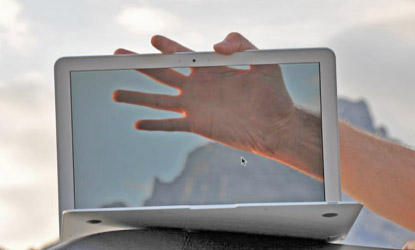
I’ll be taking a photography trip to western national parks this fall, and have been trying to think of creative shot opportunities that stray beyond the traditional “postcard shots.” One idea that’s been bouncing around my head is to juxtapose modern life with rustic wilderness. For example, I have in mind a shot that shows the Grand Tetons on a laptop screen, with the laptop floating in front of the actual Grand Tetons. With the right perspective and framing, it would look like the Tetons blend directly from real life into the laptop screen.

So I did a quick experiment tonight using this concept. The result works, I think:

And now some macro shots. Who doesn’t have an endoskull sitting around?

Cool, sure, but let’s apply some creative lighting. This next shot used a long exposure with red and blue lighting effects applied.

Another macro shot.

And now some painting with light — another technique I plan to experiment with out west. This next shot also counts as a self portrait.

One last shot, painting with light. No, I have no idea what this is. It’s abstract art.

Conga Line Tours: My Second Improv Everywhere Mission

Saturday was a beautiful day in our Nation’s Capital. Puffy white clouds floated over a deep blue sky, with pleasant temperatures and low humidity.

It was a perfect day for another Improv Everywhere mission. Back in May, I participated in my first Improv Everywhere mission: “Famous for a Day.” Improv Everywhere is a group chartered to cause “scenes of chaos and joy in public places,” producing “missions” of performance art with volunteer “agents.” In Famous for a Day, agents pretended to be fans and paparazzi, enthusiastically following a made up “celebrity” (who was also an agent). It was great fun.

The same chapter of Improv Everywhere decided to put on another event in Washington, D.C. on Saturday, August 16, 2008. We were to meet at the Navy Memorial Metro station. I arrived a bit early, so walked around the Mall a bit first, taking some pictures.

Here’s a self portrait:

As 1:30 p.m. approached, I headed back to Navy Memorial to meet up with other agents.

Bruce Witzenburg, the organizer of this event, was already in place trying to attract visitors for a “free tour.”

The premise: There are many tour companies in Washington D.C., and each one seems to provide its own gimmick. For example, there are bus tours, bike tours, trolley tours, and Segway tours.

We decided to add a new tour company to the mix: Conga Line Tours.

Conga Line Tours would provide a real, bona fide instructional tour of various spots throughout D.C.

Complete with a three-piece Conga Band.

Guests would have to dance the Conga as they went from point A to point B.

As a new company, Conga Line Tours was offering its first tour for free. To help get things going, we had plenty of agents pretending to be tourists (complete with “I love DC” t-shirts and cameras around their necks), who gladly signed up for the inaugural tour.

No dancing for me, though: My role was to secretly photograph and videotape the event.

While waiting for the event to begin, I tried to look like a tourist snapping photos of the area.

One of our agents tries to recruit guests for the free tour.

Two members of the band (left) and one of three tour guides (right) return from a quick run to Starbucks, fueling up for the tour. I like the pigeons in this shot. (They were not Improv Everywhere agents.)

More recruiting.


The band practices.

The tour group begins to form.

And then, a Segway tour group wanders by. Segways have nothing on Conga Line Tours!

The tour begins. Tour guide “Dancin Dan” begins to describe the area around Navy Memorial.

On to the next location: the Conga band, including Bongo Bill, plays a Conga beat while tour participants dance along Pennsylvania Avenue.

Next up: tour guide Jammin Janet provides a description of the J. Edgar Hoover FBI Building.


Off to the next stop.


An actual tour bus passes behind Bruce.

Once again, the event was great fun. It brought smiles to the faces of many tourists, some of who joined in the Conga line, or simply watched with bemusement as the tour group passed by. I think most people thought Conga Line Tours was real. (Professionally printed brochures certainly helped sell it.)

The band did great, and the tour guides had really done their homework. They gave a fact-filled tour, with detailed (and accurate) descriptions at each stop. One of the agents also did a good job playing the part of a foreign tourist who had just arrived in the U.S. At the Ronald Reagan Building, he deadpanned “Who is Ronald Reagan?” and the tour guide didn’t miss a beat, explaining in all seriousness who Reagan was.

Once again, I got a lot of good exercise running all around snapping photos and video.

But, after a couple hours, it was time to take the Metro home, another successful and entertaining Improv Everywhere mission under my belt.

And finally, some unedited videos I took from the event:


I Used to Be a Television Star

In 1987, I decided to make a television show.

There were a few problems. For one, I was in middle school, and barely a teenager. My voice hadn’t even changed yet.

I had no video equipment. No set. No actors. No crew. No budget. No experience.

But I was industrious, and determined.

Clarksville Middle School had just started a program called TRIAD. It provided the framework for students to explore unconventional methods of learning. Or something like that. I remember going to Mr. Paulis, the TRIAD advisor, and explaining that I would like to make a weekly television show.

“I see,” he said. “What would it be about?” he asked, perhaps humoring me.

“Hmm,” I demurred, scatching my chin. And then I said confidently and authoritatively: “Science.”

“Uh-huh,” said Mr. Paulis.

“And it will be called: Scientific Spotlight,” I added.

I had always been a fan of 3-2-1 Contact, a science educational show that ran on PBS from 1980 to 1988. (Thanks, Wikipedia!) Besides covering science, which I loved, it also had a catchy theme song, which I knew was an important ingredient for any successful television show. So I decided I would make a show in the same mold.

“Weekly, huh?” asked Mr. Paulis. “Well, OK. You’ll need to pick a topic, do lots of research, and write a script. Then we’ll see about getting a video camera.”

This was perhaps meant to dissuade me, but I took it as a greenlight and charged forward.

I sold several friends on the idea, including Brette Goldstein, Kalen Yang, and Jeff Lavis. Brette and Kalen agreed to be interviewers, and Jeff volunteered to be a cameraman.

Cast and crew was in place.

The topic was easy to choose: I had always been fascinated by lasers, and wanted to learn more about them. In the late 1980’s, lasers were beginning to show up in all kinds of places. Supermarkets had started using them to scan groceries, and the expensive and newfangled compact disk player was gaining in popularity. The Stars Wars defense program, which was talked about breathlessly on the news, depended on powerful lasers that could blow up things. This was all certainly cool stuff. But how did they work, exactly?

Opening shot from the television show. Notice the fancy titling. Lower case letters were invented subsequent to the taping of this segment.


Hey, that’s me! (And that’s me hiding behind the laser, too.)

So I began doing research. And with Mr. Paulis’s help, I started chatting with laser experts throughout Maryland.

First up, Brette, Kalen, Jeff and myself visited Dr. Russ Poch, a physics professor at a local community college.

Dr. Poch knew all about lasers, and even owned a few. With cameras rolling (*), Dr. Poch explained to Brette and Kalen all about lasers; how gases are excited, how the type of gas determines the color of the laser, and how lasers can travel through air or fiber optics.

(*): OK, there was one camera. But doesn’t it read better plural?

Here I demonstrate my excellent hand modeling skills by reflecting a bright laser beam off my palm. There was no CGI involved here, folks — that is an *actual* laser hitting my *actual* hand! The things I do for science.

Jeff did a great job videotaping the segment, but we discovered the the camera’s zoom motor was significantly louder than, say, Dr. Russ Poch. We also discovered that the camera didn’t really pick up laser light all that well. The resulting footage was, thus, “challenging.”

Dr. Russ Poch, left, explains how excited argon gas glows purple to Brette Goldstein and Kalen Yang.

Clearly, we would have to refine our techniques for capturing lasers on video. But first, there was an important field trip to make.

I decided I must visit a grocery store to find out, firsthand, how lasers are used to scan groceries.

Even better, I was authorized to take a day off from school to make this field trip. The TRIAD program rocked!

This engaging footage from Scientific Spotlight shows the excitement of a grocery store during school hours.

Ah, but there was a problem. The morning I was scheduled to visit Giant, a local supermarket, I woke up with a bad fever. I was too sick to go to school, and even too sick to go to the supermarket. I have never been so dissapointed about not being able to go to the supermarket.

But a second problem cancelled out this problem. The visit to the supermarket had been arranged by Mr. Stout. He was a history teacher at my middle school, but also worked part-time at the local Giant.

But Giant corporate had learned about this visit, and made it clear that video crews weren’t permitted to visit a store without corporate blessing and “handling.” And we did not have corporate blessing.

Mr. Paulis leapt into action, smoothing things over with corporate (who can turn down a kid trying to learn about science?), and before long we were visiting Giant and learning all about their scanning lasers and how all products across all of their stores are stored in a centralized database with real-time inventory information (right down to the number of toilet paper rolls!). That was impressive stuff for the 80’s, let me tell you.

In this award-winning shot, I can be seen holding Tic Tacs at the supermarket. Notice my clever angling of the Tic Tacs such that the bar code is aimed strategically right at the camera. It took several takes and much practice to get this effect, which looks so effortless.

So we grabbed some exciting footage of groceries being scanned.

Beep. Blip. Beep.

Really riveting footage.

Well, not so much. It was definitely time to raise the bar.

To do that, Mr. Paulis made some contacts at the Johns Hopkins University Applied Physics Lab, or APL.

APL was definitely a place of science. It had all kinds of labs with expensive laboratory equipment and people walking around in lab coats — perfect! And they had tons of lasers, which they were using for all sorts of interesting purposes.

Even better, they had a fancy video camera that was designed to capture laser light. And they offered to let us use it.

So off to APL we went.

I interview Dr. Jane Maclachlan of the Applied Physics Laboratory. For this important interview, I am wearing a Coca-Cola shirt. They were all the rage that year in middle school, sandwiched between Garbage Pail Kids and Swatch watches. Even then I had an uncanny sense of style. I, um, also had braces.

I started by interviewing Dr. Jane Maclachlan. She explained how they were developing technology to use lasers to scan surfaces such as airplane wings, looking for hairline fractures that could not otherwise be detected.

During the interview, I was careful to say “um” every few words in my questions, to keep things informal and comfortable.

Check out the fancy camera angles. Scientific Spotlight cut no corners!

Next up, I interviewed Mr. Ron Zariello, also of APL. He had some really powerful lasers. They could burn through things. I insisted on a demonstration. The laser was so bright we had to leave the room.

After dispensing with formalities, I insisted that Mr. Zariello use his lasers to destroy something. For science.

By now, I had a lot of great footage, and had certainly learned a lot about lasers and the corporate diplomacy required to bring video cameras into places of business. I wrote a final script that weaved together everything, and spent time in a professional studio editing everything together. To begin, I had to narrate the script into a microphone. This was a time consuming process, because I kept messing up.

Once the audio track was laid down, it was simply a matter of painting video on top of it. During some sections, I discovered there was no good video. For example, I had no video of Star Wars satellites using lasers to blast away missiles. So, I used my unparalleled artistic talents to produce a five-frame animation showing Star Wars in all its glory.

A frame of my animation showing Star Wars in action. The sophisticated animation technologies I invented for this scene went on to power popular Pixar movies such as Toy Story. Note, also, that the United States appears to be surrounded by water. Mexico and Canada apparently were not invented until high school.

Finally, the first episode of Scientific Spotlight was in the can.

It only took 9 months of effort to produce. A weekly series, clearly, was a bit too ambitious, especially when I had other responsibilities, such as Writing class, Physical Education, Algebra, and Home Economics. (Those responsibilities had reclaimed Brette, Kalen, and Jeff shortly after the initial taping. I am not sure where Kalen and Jeff are today, but Brette is now a big-time casting director in New York City.)

But, even though it embarrasses me greatly to watch Scientific Spotlight today, the final result was very professional and engaging.

So much so, that schools in my county insisted on showing it to incoming students at the beginning of each school year.

For many, many years to come.

All the way through high school and even into college, I would often be stopped in my home town by people who would say “hey! Aren’t you the laser guy?”

Denise Koch, a long-time anchor at WJZ-TV in Baltimore, even visited my middle school to interview me about Scientific Spotlight. She was so impressed that she invited us to visit WJZ studios. That was really eye-opening; I learned about blue screen technology for the first time, and I’ve always looked at weathermen suspiciously ever since. Who do they think they’re trying to fool, pretending to look at weather maps that aren’t there?

I was always very grateful to all the people who helped make Scientific Spotlight happen. They didn’t need to help out a little kid, but they jumped over themselves to lend a hand, just the same. I was able to repay Mr. Paulis in some way, by nominating and writing him up for the prestigious Howard County “Teacher of the Year” award. He won, and I remember the beaming smile on his face when he accepted the award.

Hiking Day and Night at Shenandoah

(Also published on DCSki.)

I had been watching the weather forecast closely in the days leading up to Sunday, July 6. “Scattered thunderstorms and rain” stubbornly remained in the forecast, with the percent chance gradually rising as Sunday approached. But, if the forecast was going to remain stubborn, I could too: I wanted to go hiking in Shenandoah National Park, and I wasn’t afraid to hike in the rain.

Thankfully, I found a friend with a similar philosophy who was also eager to hike, regardless of weather. J.R. and I hit the road at 8:15 a.m., heading to the Virginia mountains with plans to hike all day and into the night.

A deer munches on an early afternoon snack in Shenandoah National Park. Photo by M. Scott Smith.

We arrived at the Front Royal entrance of Shenandoah around 10:30 a.m., and soon saw a wild turkey scramble awkwardly across Skyline Drive. Shortly before noon, we pulled into the Big Meadows campground and parked near the firewood store, ready to start the first of two hikes.

The weather was fairly pleasant: overcast, to be sure, but not precipitating during mid-day except for an occasional sprinkle. The temperature was in the upper 70’s, but the humidity was very high and the ground was wet. The park seemed relatively uncrowded for the end of the Fourth of July weekend; scattered rain showers clearly had driven people away.

The first hike consisted of a circuit combining parts of the Appalachian Trail (AT), Rose River Trail, Dark Hollow Falls Trail, and the Story of the Forest Trail. This moderately-rated circuit has an elevation change of 1,400 feet and spans 6.4 miles. We started by walking to the Big Meadows amphitheater and then hopping on the nearby AT. We followed the AT to the Red Gate Road, and then followed that briefly to Skyline Drive. Crossing Skyline Drive, we hopped on the Skyland-Big Meadows Horse Trail, and then followed that left until it hit the Rose River Loop Trail.

A fist-sized frog (or is it a toad?) stands on a rock near the Rose River Falls trail. Photo by M. Scott Smith.

Rose River is a fun hike. Before too long, the trail catches up with Rose River, which has a number of small and large falls, including a 25-foot fall into a deep pool. The Rose River Trail also passes the remains of an old copper mine. You can make a loop out of Rose River by taking the Rose River Fire Road back to the Rose River trailhead, but you can also make a side jaunt to the base of Dark Hollow Falls.

Water cascades over the rocks along the Rose River Trail. Photo by M. Scott Smith.

Dark Hollow Falls is one of the largest falls at Shenandoah, and one of the closest to Skyline Drive. A fairly steep trail leads from Skyline Drive to the falls, and is one of the park’s most crowded trails. After resting a bit just below the base of the falls, we hiked up the Dark Hollow Falls trail back to Skyline Drive. By now, the humidity hung over the air like a wet blanket. It would have been insufferable if the temperature were in the 90’s. We worked up a sweat hiking to the top.

After hiking south down Skyline Drive, we hopped onto the Story of the Forest Trail, which leads through the woods back to the Big Meadows campground. This completed the first hike.

Flowers along Skyline Drive. Photo by M. Scott Smith.

The goal of the second hike was to climb a peak, hopefully capturing a good sunset, and then hiking back in the dark. But we had some time to kill, so we drove south along Skyline Drive, eventually arriving at the Loft Mountain Wayside, located at the 79.5 mile mark. This Wayside has a gas station (around $4.29 a gallon), a quaint gift shop, and counter food service with all the grilled staples a hungry hiker might crave.

After checking out the Wayside, we turned around, and drove north along Skyline Drive about 35 miles to the Lower Hawksbill trailhead. At 4,051 feet in elevation, Hawksbill is the highest peak in Shenandoah. An 0.8 mile hike up 750 feet will take you from the trailhead to the peak. When we arrived at the trailhead, a Park Ranger was providing medical assistance to a hiker who appeared to have banged up his knee. All of the trails were wet and slippery, so you had to be careful with your footing. Thankfully, he appeared to be OK and in good hands.

Byrds Nest 2 day shelter, providing protection from rain near the top of Hawksbill mountain. Photo by M. Scott Smith.

We began the hike up to Hawksbill after everyone else had left. Halfway up, steady rain began to fall. The mountains were shrouded in fog by the time we reached the top, and a chilly breeze blew across the mountain. After a day of heat and humidity, the cool breeze felt great, but I found myself shivering before too long. Near the top of the mountain is the Byrds Nest 2 shelter, and we sat there for awhile, listening to the rain fall, with a gut feeling that the clouds and fog might break just before sunset.

A camera-shy buck evades attempts to take an in-focus shot along the Lower Hawksbill trail. Photo by M. Scott Smith.

Apparently, though, we were unwelcome guests. Every 30-90 seconds, a small bird swooped down into the shelter, saw us, and then made a quick U-Turn, flying out of the shelter and back to a nearby tree. We noticed a bird’s nest in one of the rafters (which looked like an awfully nice, warm house, with a great view), and guessed this was the bird’s intended destination. We became convinced that the bird either wasn’t very bright, or had incredibly short-term memory, as it repeated its reconaissance flight dozens of times, in each case acting surprised that we were still there, even though it could clearly see us from its nearby perch in a tree.

The clouds suddenly part just as the sun dips towards the horizon. Photo by M. Scott Smith.

Although the rain continued to fall steadily, the clouds began to open up in the distance, revealing a setting sun. We made the short hike up to an observation platform at the peak, which provides a 270-degree view. At that moment in time, we probably had the best view in the entire state, as interesting cloud formations interacted with the sun, producing spectacular patterns and color to the west. But the east did not want to be outdone. To the east, a huge rainbow began to grow over the valley, eventually growing into a double rainbow. The sky would occasionally flash white with distant lightning. For 15 or 20 minutes, I think we were treated to what might possibly be one of the best views ever seen at the top of Hawksbill Mountain. Fourth of July fireworks had nothing on this. I’ve learned that some of the best sunsets follow rainy weather, and everything aligned perfectly at that moment in time to produce stunning views.

Photo by M. Scott Smith.


An enormous and complete double rainbow fills the view to the east. Photo by M. Scott Smith.


The right side of the rainbow. Would have been a good time not to leave the ultra-wide-angle lens in the car at the base of the trail! Photo by M. Scott Smith.


Photo by M. Scott Smith.


Photo by M. Scott Smith.


Fog billowing over the side of a distant mountain range creates the illusion of a waterfall. Photo by M. Scott Smith.


View from the top of Hawksbill Mountain, the highest peak in Shenandoah National Park. Photo by M. Scott Smith.

Eventually the rainbows faded away, the sun settled under the horizon, city lights in the valley began to twinkle in the distance, and all light drained out of the still-rainy sky. Rather than taking the Lower Hawksbill Trail directly back to the trail head, J.R. and I decided to make a circuit hike by hiking an additional 2.1 miles (for a total of 2.9), first hitting the Salamander Trail and then intersecting with the Appalachian Trail for the trip back to the trailhead.

By now it was pitch dark, and we fired up our LED headlamps to light the slippery trail. We discovered that the Salamander Trail is very appropriately named; I counted dozens of small salamanders scurrying across trail. The salamanders appeared to be at an ironic crossroad of evolution; they looked like small snakes, but had tiny feet. As a result, their movement was less than graceful — a fumbling flopping that looked like something between a slither and a crawl. Having seen how appropriately named the Salamander Trail is, I’m not sure I want to visit Rattlesnake Point Overlook, located further north in the park.

I thoroughly enjoy hiking at night. The woods take on a totally different character, and your senses heighten. You also see different types of wildlife. One type of wildlife I didn’t care to see, though, was a leech, which hopped on my leg somewhere along the descent. I was able to pluck him off quickly, but it’s the first time I’ve seen a leech at Shenandoah.

Back at the car, the only thing left to do was make the long drive home. I arrived home just after 1 a.m., exhausted and sore, but having thoroughly enjoyed a wonderful day and night at Shenandoah.

Seven Tips from Scott: Make Money Slow!

I began dabbling in the stock market in 1997. It’s been a fun ride, and I’ve learned a lot. My success can be summed up in 7 key tips:

1. Patience is a Virtue.

It’s not easy to make a lot of money in the market overnight. You really need to have patience and a (very) long-term outlook. I do a lot of homework before investing in a stock, and only invest in companies that I believe will be outperforming the overall market in 3, 5, or 10 years. I generally don’t invest in a company unless I’m prepared to hold that investment for at least 3 years. I don’t “invest and forget,” though — I continue to digest as much information about the company and market as I can, but in general I make few in-flight adjustments once I’ve picked a portfolio.

Holding a stock long-term also has significant tax advantages. Currently, the long-term capital gain tax rate (for any stock you hold for 12 months or more) is just 15%. There’s a certain joy in knowing that your money is working for you, and is only paying 15% taxes.

Patience is also key because you often don’t have a lot of principal to invest, which leads us to the second point:

2. You Don’t Need a Lot of Money

A year ago, a relative came to me with some questions about investing. She had about $1,000 in “play money” that she was willing to invest in stocks (she had never invested in individual stocks before), and I gave her some tips, but in the end she did not invest the money. Her rationale: “even if it doubled in a year, that would still only be $2,000.”

I had a discussion with a friend the other day who expressed similar reservations.

Had the relative invested that money in the stock she was looking at, she would have realized a 1-year gain of just under 80%. Her $1,000 would be worth $1,800 (before taxes). Instead, today it is worth $1,000 (or less, if you consider inflation). Granted, it could have been worth less than $1,000 — there are certainly no guarantees in the market.

But that brings us back to Point #1: Patience is a Virtue.

An 80% gain in one year is nothing to scoff at. (Heck, a 20% gain in one year is nothing to scoff at!) An extra $800 probably won’t result in any lifestyle changes — not in the first year. But if you’ve done your homework and keep that money invested, after a few years the magic of compounding begins to creep in. If you grab an 11% return on investment each year for the next 10 years, that $1,000 is now worth almost $5,000. It could be worth significantly higher if the stock has some banner years during that time. In my experience, stocks go through occasional periods where they absolutely surge. You want to be invested in them before — and during — that key period.

Let me provide a concrete example. In early 2000, I discovered an upstart restaurant chain called the Panera Bread Company (PNRA). I spent a couple months doing research on the company. This included hands-on research, which was a good thing: Panera makes yummy food and pastries. I made several observations in my research:

  • Panera was extremely efficient. All stores were modern and had an eye-pleasing and high-end design, and the company had put into place state-of-the-art business practices to monitor performance and minimize costs. For example, many of Panera’s menu items rely on fresh sourdough bread (never frozen). Panera purchased or set up exclusive arrangements with providers of this key ingredient, locating them strategically close to clusters of stores. Panera also wired all stores into a master network and received real-time statistics on sales, allowing corporate to perform all kinds of useful data mining.

  • Despite Panera’s ability to rapidly take and construct orders, every Panera store I visited was extremely busy — often the busiest restaurant around. People were willing to wait 10 or 15 minutes to get Panera food during the lunch rush. I spoke with friends and relatives across the country located near Panera stores, and they made the same observations — in Michigan, Ohio, Pennsylvania, and Maryland.

  • Panera regularly updated its menu item, always staying one step ahead of customer tastes. I was surprised by how quickly new menu items were added.

  • Panera was capitalizing on the new and growing “fast casual” market segment. Around this time, there was a backlash against fast food restaurants such as McDonalds — traditional fast food restaurants were perceived to offer low-quality, unhealthy fare. For about an extra buck per order ticket, customers could get a fresh sandwich, made with quality bread and quality ingredients. And they could eat it in a relaxed environment, with comfortable tables and chairs, and even fireplaces. There was also a perception that the food was healthier. (This is, sadly, a misplaced perception. Panera sandwiches have as much — if not more — sodium, fat, and calories as many popular menu options at fast food restaurants.)

  • I was impressed by the management of Panera. The CEO of Panera had previously co-founded Au Bon Pain. But after Au Bon Pain’s growth curve began to flatten out, his entrepreneurial spirit kicked in and he wanted new challenges. In 1993, Shaich purchased a 19-store chain of restaurants in the St. Louis area called the Saint Louis Bread Company, which he re-branded Panera. He began to grow this new concept, and in 1998, sold all of the units of Au Bon Pain. This was a difficult decision for him, but it allowed him to focus all of his efforts on growing the Panera brand — and this part was key — it allowed him to do that from a position of capital, not debt. Many restaurants start off in debt, and are lucky to ever turn a profit. Panera started on a strong financial footing — with black, not red, ink. In my mind, this significantly reduced the risk of investing in a restaurant stock. And Shaich was clearly an expert in this market and passionate about it — no pun intended, this was his bread and butter. I had always been a fan of Au Bon Pain, so I was familiar with his track record.

  • The company’s growth decisions were carefully considered and conservative. Many restaurants (such as Subway) immediately go to a franchising formula and try to maximize the number of franchise locations. They make their money on franchise fees and don’t care if two franchisees over-saturate a market and end up in competition with each other. A lot of franchisees have been taken to the cleaners in this way. Panera’s growth was much more measured. A large percent of the stores were company-owned (significantly higher than most restaurant chains), and the remainder were only given to hand-picked and carefully vetted franchisees. (Usually only ones willing to open a large number of stores in a region.) This resulted in careful quality control and helped to ensure that no market was oversaturated. Otherwise, the Panera brand could have quickly become a tired fad. (The industry is littered with examples of over-aggressive growth that eventually caved in: Boston Market, Krispy Kreme, etc.)

As you can see, I considered a lot of factors before I invested a dime in Panera. (I didn’t consider “traditional” metrics, such as P/E ratios, one bit.) Working in Chick-Fil-A in high school had given me some background on the restaurant industry and what makes a restaurant successful, and I was able to pair that with extensive research to develop a clear picture of Panera.

However, there was one problem: I was poor, and did not have that much money to invest.

On March 13, 2000, I purchased 23 shares of Panera for $6.625 per share. With commission, the total price was $172.33.

I received a bonus at work several months later and used it to purchase an additional 67 shares of Panera. And later that summer, I added another 10 shares of Panera. The total investment was about $1,000.

And then I waited. Patiently.

In 2002, Wall Street suddenly discovered Panera. Analysts began to talk up the stock, touting many of the same points I had discovered two years before. Panera’s careful growth continued unabated, with a strong balance sheet, and year-over-year growth in every location.

On June 25, 2003, Panera stock had a 2-for-1 split.

I sold my shares in Panera between late 2003 and mid-2004. Panera was still doing well in 2004, but by that point, the company was Wall Street’s darling, and the secret was out. The stock became too risky and the surprise growth story had already been told.

My original investment of about $1,000 had turned into $7,500 in about 4 years.

That’s not bad. My $1,000 in “play money” was suddenly $7,500 in “play money.” That’s definitely a lifetime supply of Panera bagels.

I turned around and re-invested that $7,500 in the market, and it’s worth significantly more today.

The original investment wasn’t that high. I just needed patience.

3. Do Your Own Research.

Wall Street analysts are bozos. There — I’ve said it. I am disgusted by all the talking heads pontificating about companies and the market, and I’m particularly disgusted by how the market reacts — in the short-term — to these bozos.

I have seen stocks move significantly (in some cases 10% in a day) based on public statements by analysts that I knew were flat-out wrong.

I’ve blogged about this sort of thing in the past. For example, one master analyst made this following bold proclamation in early 2007, discussing the possibility of a merger between XM Radio and Sirius:

    “… in a Banc of America Securities report, analyst Jonathan Jacoby put the probability of [government] approval of the merger at about 35 percent, but noted that it was likely much lower.”

Or, here’s a statement from wizard analyst Richard Farmer of Merrill Lynch from years past:

    “Farmer said he expects Apple to exceed his own earnings forecast of 37 cents a share.”

It’s breathtaking, isn’t it? What kind of analysis do you think goes into coming up with scientific-sounding numbers like 35% or 37 cents? Really insightful analysis, I bet. But analysts don’t just come up with these scientific-sounding numbers. They then wrap them with clever disclaimers that let them claim victory regardless of the results. (Hint: if you believe the merger chances are lower than your estimate, lower your estimate.)

What’s always annoyed me is that companies and investors are hurt when their actual performance doesn’t match the voodoo predictions of these brilliant analysts.

But I’ve discovered something: if you follow my first piece of advice — patience — and do your own research, and have a strong stomach (see next point), analysts always fall into the noise.

Because the market is self-correcting.

An analyst’s proclamation might cause a stock to fall significantly in the short term, but if the company is sound, actual results will quickly erase any effect of analyst pontifications. Because eventually the facts trounce everything. And you are investing for the long term, right? If you invest for the short term, you will be held hostage to the whims of Wall Street analysts.

The key thing here is to ignore analysts and do your own research.

Because the analysts are usually wrong. And if you’re following an analyst, everyone else is too. You want to find opportunities that are under the radar of Wall Street and the analysts. I have taken advantage of two types of opportunities:

  • Discovering a promising company (such as Panera) before the market catches on. But there are lots of promising companies that never take off. You have to do your own research to get a gut feeling for whether a company has what it takes to surprise the market and succeed.

Peter Lynch famously suggested years ago to “buy what you know.” This advice is timeless, although I would amend it to say “consider what you know.” What you know may lead to opportunities, but the next step is to research those opportunities. Study opportunities in markets that are geologically close to you, or ones that you already have an expertise in. But then divorce your expertise from the equation and try to look at the company objectively. And even though a store might be doing gangbusters in your neighborhood, that doesn’t mean the formula will translate to a national growth one.

  • Some promising companies suffer from a stigma that is unfounded. In the late 90’s, you could not find a story that mentioned Apple Computer without attaching the word “beleaguered.” This drove Apple stock to a split-adjusted low of less than 2 dollars per share. But I knew Apple’s products, saw the potential, considered factors such as the growth of the Internet, and zagged when everyone else zigged. Apple has been one of the best performing stocks on the market over the past decade. (Guess what? All of those analysts were wrong!) If you had invested in Apple when it was “beleaguered,” you’d be looking at an ROI of around 8500% today. Now, there are lots of beaten-down companies that never claw their way back to health. Once again, doing your own research is key. But you might find a gem or two that has already been written off by the “experts.”

4. Have a Strong Stomach

The market suffers from huge swings, and it is hard to be patient when you see one of those swings take a huge swipe at your investment and principal. Even if a company is healthy, an unforeseen event such as 9-11 can have a big impact. You can’t predict these events; you can only do your research, make sound investing decisions, and then hang on for the long term. There have been plenty of times when I have been tempted to panic and pull money out. I never did. Instead, having done my homework for the long term, I chose those times to buy more shares. Again, zag when others zig. And:

5. Dollar Cost Average Anytime You Can

Dollar cost averaging is a wonderful thing. By purchasing small amounts of stock or mutual funds at regular intervals, you even out the differences in price and minimize the overall risk. If you’re averaging in when the market is low, you’re getting extra bang (or shares) for your buck. The market is cyclical and there are inevitably times when the market goes down. If all of the factors that led me to purchase a stock are still in place, I use these times to buy extra shares at a discount. Everyone loves a discount!

6. A Down Market Can Be a Blessing

Everyone gets depressed when the market is down (such as right now), but for a young investor, this is a time to celebrate — and a time to invest, even if you don’t have much money to invest. Over the long run (decades), the stock market tends to be the best investment you can make — returning an average return of 10% or more. (Of course, individual stocks can do far better or far worse.) But those stocks don’t return 10% every year. They may go several years with steep losses, followed by relatively short burts of appreciation. Those short bursts are wholly responsible for those long-term average gains, and they’re relatively infrequent. You want to be on the roller coaster car when it starts up that climb. To do that, hop in when the market is down.

7. It’s OK to Take Profits Now and Then

And finally, it’s OK to sell your stocks when they’ve done well, or to lower your position. Don’t become attached to a stock just because it has done well for you. It was difficult for me to sell Panera at a time when analysts were all saying “strong buy.” I loved the company, and I loved the gains I had made, but I knew it was time to go. One of the original factors for buying the stock — that it was a relative unknown — no longer applied. Since I sold, Panera has done OK, but the stock has been relatively flat. It certainly hasn’t had the types of gains it had in those first several years. I was able to move the proceeds into companies that were still at the bottom of their own roller coaster hills.

From the (Really Old Film) Archives: Timber Lake Trail

I’ve taken several road trips out west, and on each trip I’ve lingered in Colorado. Colorado is a nice place to linger. I’m glad that I lingered there for the first 13 years of my life.

On one road trip a number of years back, I spent several days camping and hiking in Rocky Mountain National Park.

Under the dim glow of a flashlight, I huddled in my tent the first night and pored over topographic maps trying to pick out a hike for the next day, eventually settling on Timber Lake Trail. In the distance, I could hear the sound of elk bugling. In fact, those elk bugled all night long. They were very inconsiderate elk.

The next morning, I packed up my tent, and learned from nearby campers that a black bear had been milling about by my tent for much of the night. I was completely oblivious to this. Apparently other campers were quite alarmed by the bear’s proximity to my tent, but, naturally, had made no attempt to warn me, glad that the bear wasn’t milling about by their tent.

I made my way to the trailhead, glad that I had escaped a more personal encounter with a bear, and was greeted by a posted sign warning that a mountain lion had recently attacked a hiker on the very trail I was about to hike.

In bold letters, the sign helpfully warned “MOUNTAIN LIONS FREQUENTING THIS AREA — BE ALERT — SOLO HIKING AND JOGGING NOT RECOMMENDED.”

Although I had no intention of jogging, I couldn’t help but notice that I was alone.

This led to a few minutes of consideration. On the one hand, there was a mountain lion on this trail picking off humans, especially solo hikers. On the other hand, I was skinny; why would a mountain lion bother with me? I probably survived the scary bear milling encounter for the same reason.

So I decided to chart ahead. I was there, and I was going to hike. I didn’t drive through Kansas for nothing. For protection, I brought a road flare, and stashed it in my backpack. Evidently, I thought that if a mountain lion suddenly lunged towards me, in a split second I would have time to take off my pack, remove the road flare, strike it to ignite it, and then wave it in front of the lunging lion to scare it off.

So, yeah, it provided plenty of peace of mind.

Timber Lake is a 9.6-mile hike, with an elevation gain of 2,050 feet. The trail ends at 11,060 feet above sea level, in a meadow and glacial lake, surrounded by towering mountains and right on the intersection with the treeline. It’s also fair to say that the trail ends in a postcard.

Most of the trail goes through dense forest, slowly climbing its way up.

During the hike up, I took a total of one picture. (The following photos were prints that were “scanned” by me aiming my digital camera at them, because I’m too cheap to buy a real scanner. So the quality ain’t great. The original pictures were taken with a film camera. You can learn more about film cameras at your local Smithsonian museum.)

Here is a photo showing the trail:

Why only one photo? I think I was nervous about getting mauled by a mountain lion. And nothing attracts mountain lions more than the casual sound of a camera’s shutter releasing. It’s like the sound of a can opener to a housecat. I figured as long as I was moving at an even pace (but not JOGGING, for heaven’s sake! I read the warning sign — at least half of it!), the mountain lions would leave me alone.

But, all kidding aside, I didn’t linger because I was anxious to reach the top of the trail, and was worried about getting stuck above treeline in an afternoon thunderstorm.

The trail turned out to be a tease. Growing more exhausted, I kept expecting and hoping to see Timber Lake appear around the next bend. There were lots of bends; there was no Timber Lake. But, eventually Timber Lake made its debut.

And it was worth the wait. There I was, in one of the most serene and scenic places I had ever been. There wasn’t a soul around. Rocky peaks surrounded me and reflected off the crystal-clear water. Even though it was the middle of the summer, there were piles of snow around. It might have been chilly, if it weren’t for the bright Colorado sun shining down. I made my way around the lake, snapping photos, and eventually hopped across stones to a big island of a rock surrounded by water. I sat on this rock for awhile, taking in the sights, sounds, and smells while munching on a granola bar or two. I noticed some movement in the rocks above, and counted at least a dozen bighorn sheep. I looked up at them, and they looked down on me. I couldn’t help but be jealous; this was their home.


←Older